UN report on Rwandan support of M23 not good

The UN’s Group of Experts report on Rwandan support and backing of the M23 mutiny in Congo paints a very scary picture. M23 is a group of soilders and officers who have revolted against the central government in Kinshasa. Led by alleged war criminal Bosco “Terminator” Ntaganda, M23 has been fighting in the Kivus region of Congo for several months now. Along with Laurent Nkunda and Sultani Makenga, the DRC and now the UN allege that M23 has been receiving direct support from the government of Rwanda including ammunition, arms, health care, fresh recruits, and training. The Group of Experts also alleges that Kigali was instrumental in starting the rebellion; hoping to dominate Congo as well as annex the Kivus, whose population has strong ethnic ties to the Tutsi dominated government in Rwanda. High level face to face meetings between M23 members and Rwandan military and intelligence officials have also allegedly taken place on a regular basis. Rwanda has long interfered in the internal politics of its large neighbor, as well as exploiting it vast mineral wealth in the east. The Unites States, which counts Rwanda as a close ally, is beloved to have been behind the lobbying effort at the UN to stop the report from coming out. For more detailed information on M23 and Congo in general check out Jason Stearns blog Congo Siasa

Below are excerpts from the report obtained by Colum Lynch and published in Foreign Policy Magazine:

Since the outset of its current mandate, the Group [of Experts] has gathered evidence of arms embargo and sanctions regime violations committed by the Rwandan Government. These violations consist of the provision of material and financial support to armed groups operation in the eastern DRC, including the recently established M23, in contravention of paragraph 1 of Security Council resolution 1807. The arms embargo and sanctions regimes violations include the following:
*Direct assistance in the creation of M23 through the transport of weapons and soldiers through Rwandan territory;
*Recruitment of Rwandan youth and demobilized ex-combatants as well as Congolese refugees for M23;
*Provision of weapons and ammunition to M23;
*Mobilization and lobbying of Congolese political and financial leaders for the benefit of M23;
*Direct Rwandan Defense Forces (RDF) interventions into Congolese territory to reinforce M23;
*Support to several other armed groups as well as FARDC mutinies in the eastern Congo;
*Violation of the assets freeze and travel ban through supporting sanctioned individuals.
Over the course of its investigation since late 2011, the Group has found substantial evidence attesting to support from Rwandan officials to armed groups operating in the eastern DRC. Initially the RDF [Rwandan Defense Forces] appeared to establish these alliances to facilitate a wave of targeted assassinations against key FDLR [The Democratic Forces for the Liberation of Rwanda, the armed remnants of Rwanda’s former genocidal government] officers, thus significantly weakening the rebel movement (see paragraphs 37 & 38 of interim report). However, these activities quickly extended to support for a series of post electoral mutinies within the FARDC [The Congolese Armed Forces] and eventually included the direct facilitation, through the use of Rwandan territory, of the creation of the M23 rebellion. The latter is comprised of ex-CNDP officers integrated into the Congolese army (FARDC) in January 2009. Since M23 established itself in strategic positions along the Rwandan border in May 2012, the Group has gathered overwhelming evidence demonstrating that senior RDF officers, in their official capacities, have been backstopping the rebels through providing weapons, military supplies, and new recruits.
In turn, M23 continues to solidify alliances with many other armed groups and mutineer movements, including those previously benefiting from RDF support. This has created enormous security challenges, extending from Ituri district in the north to Fizi territory in the south, for the already overstretched Congolese Army(FARDC). Through such arms embargo violations, Rwandan officials have also been in contravention of the sanctions regime’s travel ban and assets freeze measures, by including three designated individuals amongst their direct allies.
In an attempt to solve the crisis which this Rwandan support to armed groups had exacerbated, the governments of the DRC and Rwanda have held a series of high-level bilateral meetings since early April 2012. During these discussions, Rwandan officials have insisted on impunity for their armed group and mutineer allies, including ex-CNDP General Bosco Ntaganda, and the deployment of additional RDF units to the Kivus to conduct large-scale operations against the FDLR. The latter request has been repeatedly made despite the fact that: a) the RDF halted its unilateral initiatives to weaken the FDLR in late February; b) RDF Special Forces have already been deployed officially in Rutshuru territory for over a year; c) RDF operational units are periodically reinforcing the M23 on the battlefield against the Congolese army; d) M23 is directly and indirectly allied with several FDLR splinter groups; and e) the RDF is remobilizing previously repatriated FDLR to boost the ranks of M23.
* * *
Elevated Standards of Evidence:
In light of the serious nature of these findings, the group has adopted elevated methodological standards. Since early April 2012, the Group has interviewed over 80 deserters of FARDC mutinies and Congolese armed groups, including from M23. Amongst the latter, the Group has interviewed 31 Rwandan nationals. Furthermore, the group has also photographed weapons and military equipment found in arms caches and on the battlefield, as well as obtained official documents and intercepts of radio communication. The Group has also consulted dozens of senior Congolese military commanders and intelligence officials as well as political and community leaders with intricate knowledge of development between DRC and Rwanda. Moreover, the Group has communicated regularly with several active participants of the ex-CNDP mutiny, the M23 rebellion, and other armed groups. Finally, while the Group’s standard methodology requires a minimum of three sources, assessed to be credible and independent of one another, it has raised this to five sources when naming specific individuals involved in these case of arms embargo and sanctions violations.
* * *
Rwandan Support to M23:
Since the earliest stage of its inception, the Group documented a systematic pattern of military and political support provided to the M23 rebellion by Rwandan authorities. Upon taking control over the strategic position of Runyoni, along the Rwandan border with DRC, M23 officers opened two supply routes going from Runyoni to Kinigi or Njerima in Rwanda, which RDF officers used to deliver such support as troops, recruits, and weapons. The Group also found evidence that Rwandan officials mobilized ex-CNDP cadres and officers, North Kivu politicians, business leaders and youth in support of M23.
* * *
Direct Rwandan assistance in creation of M23 through Rwandan territory:
Colonel Sultani Makenga deserted the FARDC in order to create the M23 rebellion using Rwandan territory and benefiting directly from RDF facilitation (See paragraph 104 of interim report). On 4 May, Makenga crossed the border from Goma into Gisenyi, Rwanda, and waited for his soldiers to join him from Goma and Bukavu. Intelligence sources, M23 collaborators and local politicians confirmed for the Group that RDF Western Division commander, General Emmanuel Ruvusha, welcomed Makenga upon his arrival to Gisenyi. The same source indicated that Ruvusha subsequently held a series of coordination meetings with other RDF officers in Gisenyi and Ruhengeri over the following days with Makenga.

Rwandan officials have also been directly involved in the mobilization of political leaders and financial backers for M23. Based on interviews conducted with M23 members, ex-CNDP officers and politicians, intelligence officers, FARDC [Congolese Army] senior commanders, the Group [of Experts] has established that Rwandan officials have made extensive telephone calls and organized a series of meeting with Congolese politicians and businessman to promote and rally support for M23.
Throughout the Group’s investigations, it has systematically gathered testimonies from former M23 combatants, M23 collaborators, ex-RDF [Rwandan Defense Forces] officers, Congolese intelligence, FARDC commanders, and politicians which affirm the direct involvement in the support to M23 from senior levels of the Rwandan government.
a) General Jacques Nziza, the Permanent Secretary of the Ministry of Defense, supervises all military, financial, and logistic support as well as mobilization activities related to M23. He has recently been deployed to Ruhengeri and Gisenyi to coordinate M23 assistance and recruitment.
b) General James Kabarebe, the Rwandan Minister of Defense, with the support of his personal secretary Captain Celestin Senkoko, also is a central figure in recruitment and mobilizing political and military support to M23. Kabarebe has often been in direct contact with M23 members on the ground to coordinate military activities.
c) General Charles Kayonga, the RDF Chief of Staff manages the overall military support to M23. Kayonga is frequently in communications with Makenga and oversaw the transfer of Makenga’s troops and weapons through Rwanda.
d) The military support on the ground has been channeled by General Emmanuel Ruvusha, RDF Division commander based in Gisenyi, as well as General Alexi Kagame, RDF Division commander based at Ruhengeru, Both facilitate recruitment of civilians and demobilized soldiers to M23 as well as coordinating RDF reinforcements in Runyoni with M23 commanders.
e) Colonel Jomba Gakumba, a native of North Kivu, who used to be an RDF instructor at the Rwandan Military Academy at Gako, was redeployed to Ruhengeri since the creation of M23, where he has been in charge of commanding locally military operations in support of M23.
Ex-RDF officers, politicians, M23 collaborators also informed the Group that Ntaganda and Makenga have been regularly crossing the border into Rwanda to carrying meetings with any of the above mentioned senior RDF officers at Kinigi, on several occasions. Those same sources also stated that former CNDP chairman General Laurent Nkunda, officially under house arrest by the Rwandan government since January 2009, often comes from Kigali to participate in these meetings.
Annan backs off letting Iran negotiate in Syria

Kofi Annan has been pushing for some time now to have Iran help negotiate an end to the civil war in Syria.  As one of Syria’s few remaining allies Iran could play a very important part in helping to end the violence.  Unfortunately this will not happen.  On Wednesday Annan announced that Iran will not participate in the peace talks scheduled for Saturday in Geneva.  The current roster for the peace talks include the United States, Britain, China, France, Russia and Turkey.  It’s patently clear that the United States did not want Iran to have a seat at the table.  Letting them participate might have gone towards acknowledging that Iran has power and influence, which runs counter to the narrative concocted by the United States.  The US believes that maintaining the perception that Iran is weak and isolated will help them in succeeding to stop their nuclear program.  Of course this is unfounded and arrogant, but plays well for the domestic audience here that views Iran as a threat.  Congressional push back on Iran as a negotiator was also very loud.  Those in Congress preaching about ending the crisis seem to care more about sticking it to Iran than actually bringing about an end to the violence.

Whatever happens in Syria will have an impact on Iran.  As both a friend and neighbor to Assad, Iran will be a factor in whatever happens.  By cutting them out of the discussion Annan has insured that the role Iran plays will be more adversarial towards the West and those pushing for regime change than if they were involved in peace talks.  This represents yet another example of how the civil war in Syria is being fought over by world powers in a very complicated game of geopolitical chess.

The Fast and Furious Circus

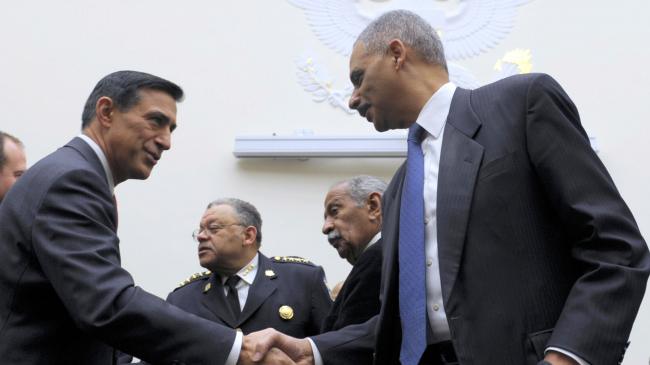
The circus that has surrounded House Oversight and Government Reform Committee Chairman Darrell Issa’s investigation into the Fast and Furious gun walking program is soon to enter the grand finale.  The House floor will vote today on whether to hold Attorney General Eric Holder in contempt of Congress.  Now I am not going to sit here in judgement of  AG Holder or Rep. Issa.  Did Holder lie to Congress about what he knew?  Of course he lied but that wouldn’t be the first time an official lied during a Congressional hearing.  Is Issa pursuing Fast and Furious for political points?  Well of course this is Issa’s ultimate goal, and yet this wouldn’t constitute the first instance of a Congressman hounding someone for political purposes.

All fights like this in Washington miss the real root of the problem.  Instead of dealing with the very real and dangerous problem of Mexican cartels buying guns just across the border Congress is more concerned with seeing if Holder lied.  This is similar to the current leaks investigation.  No one seems to care that the President has a death panel to decide which “terrorist” to kill.  They care only that the media and public found out about it.  Any time that Fast and Furious is discussed in the media or in Congress it is only to denigrate AG Holder for not telling the truth, not on the fact that hundreds of guns cross the border and into the hands of the cartels.  There are no voices within the GOP railing about the ease with which cartels can legally purchase guns in the U.S. for transport to Mexico.  On the contrary, many Republicans view what the ATF does as counter to the rights of gun owners.  They cite ludicrous reports that cartels purchase arms in Guatemala not the US.  Ludicrous because no business minded cartel would go through all the trouble and money of transporting guns from their southern border up to the north where the fighting is when the US is spitting distance away.  Again all Republicans seem concerned with is embarrassing the administration.

Democrats play a part in this three ring circus as well.  Several Democrats in conservative leaning distracts are being leaned on by the NRA to vote in favor of contempt.  Afraid of losing their seats some Democrats will break party lines and vote in favor of contempt.  Further politicizing the scandal are those calling the attack on Holder racial.   The Congressional Black Caucus plans to walk out of the House during the vote.  While some sort of racial component might have something to do with going after Holder, although it seems like a bit of a stretch, the CBC are blindly defending Holder simply because of this race.  They fail to see the problem and fact that Holder probably did lie to Congress.  More importantly they are shifting the discussion away from arms trafficking.  Democrats in general have been too eager to support the administration on this.  As with all of the criminal things that the administration has done i.e. signature drone strikes, Democrats have somehow been able to justify this to themselves.  Many seem to think that Holder not telling the truth is somehow different because he is a Democrat and not a Republican.  And while some Dems have been bringing up the real issue of how these guns make it into Mexico their calls are fewer and fewer.  Instead they are just as caught up in the political food fight that their counterparts across the aisle are.  Coming out on top in the battle over who did or didn’t lie is more important.  They care as much about arms trafficking and the death of Border Agent Brian Terry as Republicans do, not at all.  In the end the arms trade that fuels the violence over the drug trade will continue with no change from Washington.

AFP on controversial Israeli military training program

AFP has a terrific underreported story on an Israeli military training exercise that targets innocent Palestinians. Unsurprisingly this has not made it to the front pages of newspapers here in America.

As the Shawakha brothers rushed to protect their home from intruders, they had no clue they were unwitting participants in an Israeli army exercise that would leave one of them dead.

“It was March 27, 1:30 in the morning,” recalls Akram Shawakha, 36, who was on watch duty on the top floor of the modest family home on a hill east of the West Bank city of Ramallah.

Their house is on the outskirts of the wealthy village of Rammun, where most residents have emigrated to America.

“I saw two men dressed in ordinary clothes near the entrance,” said Akram, a cement factory worker who was taking the first shift on guard duty to keep an eye on the family’s 10 sheep and their car from would-be thieves.

Clutching a stick, Akram went down to wake his brothers — 39-year-old Anwar and 28-year-old Rashad — then went outside as they got dressed and picked up a knife to protect themselves.

Akram confronted the two strangers, addressing them in Arabic “which they spoke perfectly,” he recalls.

“I asked them who they were.

“One of them said: ‘Don’t worry, we know everyone in Rammun.’ We insisted on seeing their identity papers, and they put their hands in their pockets and pulled out their guns, not to threaten us, but with the intention of shooting.”

Gunfire erupted and a confused melee ensued. The three brothers suffered bullet wounds although they managed to throw blows of their own as they fought.

“Everything happened in less than a minute,” Akram says.

“Then Israeli soldiers in uniform arrived and we were ordered to stop. My brothers were lying on the ground, injured. I asked the soldiers for help.”

The two “intruders” were quickly whisked away in a military vehicle as the three brothers waited, lying on the ground. At one point, “a soldier fired a round at the ground, injuring Rashad further,” Akram says.

Eventually the three brothers were taken to an Israeli hospital.

Rashad died on April 2.

The story was picked up by the Israeli media, which soon discovered that the two “intruders” were in fact soldiers participating in a training exercise by the “Dudevan” military unit, which specialises in infiltrating Palestinian areas disguised as Arabs.

Shortly after the two surviving brothers were released from hospital, they filed a complaint through the Israeli rights group B’Tselem.

On April 24, nearly a month after the incident, the military prosecutor informed B’Tselem that it had opened an investigation.

The military has repeatedly refused to comment on the investigation, saying only that it is ongoing.

“It wasn’t until I was at the hospital that I understood the people we confronted were soldiers,” Anwar Shawakha told AFP, saying he had only realised what had happened when an army officer called “Adam” told him during his interrogation.

“Their lives were never in danger. We just wanted to know their identity, but their identity was their guns,” he says.

“We thought they were thieves. At no point did they mention Israel, nor the army, nor did they order us to go back into the house, otherwise none of this would have happened,” he sighs.

“Rammun is a quiet village.”

Using Palestinian villages as a training ground for undercover Israeli troops is not uncommon. In 2007, the practice prompted Israeli NGO Yesh Din to complain to the military’s top legal adviser, warning the exercises could endanger both Israeli and Palestinian lives.

Yehuda Shaul, founder of Breaking the Silence, a group of former Israeli soldiers critical of army practices in the occupied territories, says such exercises have increased in recent years.

“As the West Bank becomes more and more secure, security-wise, there is more and more training on ‘live’ Palestinians,” he told AFP.

Back during the violence of the second intifada (2000-2005), the security situation was too dangerous for troops to carry out such undercover work, but since then, the army has been taking advantage of the calm for training purposes.

“Now training on Palestinians is not putting the troops in danger, so as the West Bank becomes more and more calm, we hear more and more of these stories,” he said.

A newly trained unit doesn’t want “their first arrest operation to be carried out on a real sting, on a really wanted person,” he explains.

“So you pick a quiet village in the area where you’re based, you open the map, choose a random house … You go in the middle of the night, you surround the house, you grab a guy as if it’s a real arrest.”

The argument is that training “has to be as close to the real thing” as possible, he said.

“It is another form of what we call in the army ‘Making our presence felt’ — if Palestinians get the feeling that the army is everywhere all the time, they will be afraid to attack,” Shaul told AFP.

“When you control people under military occupation for so long, you’re starting to play games. Individual soldiers play games at checkpoints with people, and the big army plays games with villages.”

Some facts you should know before you enter the spin war

Mohammad Morsi has officially won the first democratic election in Egypt. But the most significant event in Egypt’s history since Nasser overthrew King Farouk has been sidelined by many in the West. The principle players in the spin war are many of the neoconservatives that brought us the Iraq war. Fox News unsurprisingly has come to the forefront of the spin war to paint the Muslim Brotherhood ascent to power as the most dangerous world event. This morning they had Egypt expert Donald Trump on “Fox and Friends” railing against President Obama’s policy towards Egypt. Trump proclaimed that the administration should have supported Mubarak because he was our “friend” as well as a “friend” to Israel. Later in the day Fox had the lamentable warmonger John Bolton on the air spewing a litany of lies about the ramifications of Morsi as president. So before you get sucked into the spin war it is important to know several key facts about the reality of the situation.

The SCAF is still in totally in control the nation. Many alarmist politicians and pundits have begun proclaiming that Morsi will bring about a radical Islamist agenda to his presidency. This notion is one hundred percent wrong. Morsi has no real power. The SCAF’s June 17 constitution consolidated all power into the hands of the military. Foreign policy and control of the military are solely controlled by Tantawi and his cronies. The June 17 constitution also granted veto power to the military; ostensibly making Morsi little more than a figure head. Dissolving parliament has also ensured that the SCAF will control all aspects of governing in Egypt.

Pro-Israel fanatics have also been raising alarm bells over Morsi’s presidential win. They claim that the Brotherhood government get rid of the long standing peace deal between the two nations. This they fear will usher in a new wave of violence that will threaten “poor defenseless” Israel. There is no way that Morsi will throw out the peace deal between Egypt and Israel. He has nothing to gain from this. While many neo-cons think that the Brotherhood has some diabolical plan to destroy Israel this notion is also incredibly far fetched. Egypt faces many problems in the coming years the least of which has to do with the Jewish state. Unemployment, poverty, and a weak economy are going to be at the forefront of issues that the incoming government must tackle. Why would they decide to take on the most powerful nation in the region? Israel would easily crush any sort of military incursion by Egypt with or with out the aid of America and Europe. Those expressing these irrational and unfounded fears of a hostile Egypt fail to understand the real reasons for such hostility in the first place. It was Mubarak himself who stoked such anger towards the Israelis, not the Brotherhood. Mubarak’s close personal relationship with a nation that brutalized fellow Arabs ais what gave rise to anti-Israeli sentiment. Lastly, Morsi was very clear in his acceptance speech that he would continue all of Egypt’s

Holder’s Dereliction of Duty

Pro-Herman Cain Super PAC Cain Connections always has the best adds.

Saved

Old add brought to you by pro-Romney Super PAC Restore Our Future.  Still a good one though.

Rough new add by Priorities USA

New add brought to you by pro-Obama Super PAC Priorities USA

Syria’s breaking point

The latest escalation of tensions between Syria and Turkey threaten to bring the conflict to a horrifying new level. Details are still murky as to why Syrian shot down a Turkish F4 Phantom. Syria did not dispute that they had shot down the plane; perhaps an overreaction but still a legitimate response to their breach of sovereignty. On Saturday Turkey did admit that they had entered Syrian airspace, yet back tracked somewhat on Sunday, saying that the plane was in fact shot down in international waters. It is safe to bet that Syria does not want a military confrontation with their neighbor. Turkey’s armed forces far out number Syria’s. And military confrontation would be disastrous for both nations. This is also the second reported attack onTurkish military personal. Syria also fired at Turkish troops guarding a refugee camp just over the border.

No doubt calls for some form of intervention will become louder in the following days. Turkey is said to be invoking article IV of the NATO charter which calls for high level meetings with all NATO members; military options have not been taken of the table.

An event like this could end up being the straw that broke the camels back. As many will remember it was the shooting down of Habyarimana’s plane that sparked the genocide in Rwanda. While this incident is much different the same basic principle remains.

The downed Turkish fighter jet could prove to be the catalyst for an intervention. All the rhetoric from the West (Saudi Arabia an Qatar included) about not wanting to cause more bloodshed is nothing compared to their the drive to oust Assad from power. Getting rid of Assad is viewed by the Americans and the Gulf states as key to weakening Iran. Turkey in turn wants to ascend to the mantle of regional power in the Middle East. Both sides have been itching for justification to get involved. Saudi Arabia and Qatar have gone do far as to say NATO and the Arab League could circumvent the UN by declaring war themselves.

The real net losers will undoubtedly be the Syrian people. Their goals of being free from repression and violence will go the way side in the face of the geopolitical goals. The Saudis care nothing for the plight of the average Syrian. They care only about maintaing hegemony through out the Sunni Arab world. Human rights and free speech will mean nothing when civil and regional war break out. And will mean even less to the theocratic dictators in the Gulf. Those advocating for intervention in the West should be weary that the loudest voices advancing this are some of the most repressive countries in the world. An endless cycle of violence will ignite through out the Middle East that will never end and will never be resolved. In the end the only winners will be the Saudis and Qatari’s.

Just to clarify, Afghan security is not improving

The recent attack yesterday on the Afghan resort in Qaragha lake is yet another blow the American narrative that Afghan forces are ready to take over.  With ISAF leaving in two years time, a massive propaganda effort has been under way to show Afghan forces as competent and reliable.  Nearly all ISAF press releases laud the Afghan military as the strongest institution in the country.  Yet it was the Norwegian special forces who were responsible for the leading the operation that finally put an end to the bloodshed  at the lake resort.  As reported in McClatchy “reporters at the scene observed Norwegian special forces – trainers for the Crisis Response Unit, Afghan police commandos who supposedly had the lead in the operation – raiding the restaurant where the attackers were holed up, helping to bring an end to the fighting.”  In General John Allen’s press statement on the operation he noted that ISAF support was minimal.  This differed from the McClatchy reporters who “observed the Norwegian forces quietly removing from the scene rocket-launcher tubes that are used by NATO forces, not Afghans, a further sign that the international troops were heavily involved in the operation.”  Even if we were led to believe that the Afghan armed forces were improving the same can be said of the Taliban.  Taliban fighters time and again have shown that they can easily take hold of and maintain sieges of large buildings.

The other half to ISAF’s propaganda war against the Taliban revolves around portraying Afghanistan’s security as improving.   In the past five days at least 24 people have been killed in several different Taliban attacks.  The Afghan public by and large believes that security has deteriorated, and have little faith in an army they view as corrupt, illiterate, and incompetent.  The Taliban are by no means on the run.  So far their summer fighting season has proved to be going splendidly.