Category Archives: Africa

M23 had “external support”

20130220-132851.jpg

More proof that the M23 rebel movment is a corrupt puppet army was provided yesterday by the UN Secretary General Ban Ki-Moon. Referring to a three month report conduced by MONUSCO peacekeepers, Ban stated that the M23 movment had “external support” when they seized Goma in November of 2012. While this is a welcomed announcement, it is disappointing that Ban did not state who this external actor was. Especially since the UN has already stated the Rwanda and Uganda are the benefactors of the M23 movement; funding, controlling and providing the actual rebels themselves. We can most likely assume this is yet more arm twisting by the imperial US government and by the reprehensible warmonger Susan Rice.

Disinformation on Mali

There is a tremendous amount of disinformation that is circulated in the mainstream/corporate media with regards to the current situation in Mali. The best example of this would be a recent interview that Brian Lehr did with Morehouse college professor Laura Seay discussing her recent article in Foreign Policy titled, “Mali is not a Stan.” Like everyone else in the mainstream/corporate Seay doesn’t think that France has any interest in the massive gold and uranium reserves, she in fact lies and says the reserves are small, and omits any discussion of AFRICOM, which with the help of Lehr leaves the citizen brainwashed into thinking that intervention and the West are forces for good in Africa. It’s alright to send in foreign troops to bomb and murder Malians because as Morehouse professor Laura Seay says in her article the government of Mali, headed by a military junta commanded by the American trained Capt. Amadou Sanogo, asked the French to come in and help. Why how else are we going to stop those Islamist terrorists from taking over? Unfortunately a lot of people will absorb this sort of drivel and really believe it. Don’t bother reading the article or listening to the interview unless you want to be propagandized to by a bunch of hacks.

For a brief but much more nuanced explanation for the current situation in Mali check out this segment from RT with F. William Engdahl, research associate at Global Research.

AFRICOM and President Obama’s horrifying vision for a militarized Africa is disturbing to say the least. AFRICOM is perhaps the most despicable Bush era foreign policy that Obama has embraced so enthusiastically. If you really are interested into exploring how far down the rabbit hole the situation in Mali goes I suggest the following article’s:

Mali and AFRICOM’s Africa Agenda: Target China

Following the money trail: Mali, Wahabis and Saudis


How Washington helped foster the Islamist uprising in Mali

Charles Ble Goude resurfaces

Charles Ble Goude, head of the ultranationalist Young Patriots, has resurfaced. Ble Goude fled Cote d’Ivore during the recent conflict between the north and south in 2010-2011. As head of the Young Patriots Ble Goude was instrumental in rallying thousands of young Ivorians to fight northern rebels. Ostensibly the Young Patriots were the youth wing of former President Gbagbo’s party. In reality it was a militia that was responsible for the deaths of countless Ivorian’s and foreigners. Ble Goude has been silent for over a year. Sightings of him have been reported in Ghana, Liberia,Togo, Gambia and Angola. In his telephone interview with the AP he never revealed his location; although poor reception on the phone line suggests he is not in a populated area. His interview seemed only to serve as a platform from which to proclaim his innocence.

“Can you show me a single video, or a single audio, where I asked the youth of Ivory Coast to hurt foreigners?”

“I organized a struggle with bare hands in order to oppose the taking of power by the arms. Madam, is this something that should result in me going to the International Criminal Court?”

“I have said it, and I repeat it – If I am asked to go to the ICC, I’m ready to go to the ICC.”

“What you are saying is totally removed from reality. I never asked the young people to put up checkpoints in order to identify the foreigners – that’s not true!”

“The young people they put up checkpoints to see if the people living in their neighborhoods, or in different neighborhoods, are armed or not … I never asked anybody to put up barricades so as to control the foreigners. This isn’t true! It’s your own invention.”

There is no doubt that northern rebels, aided by France and the UN, committed horrible war crimes. Nonetheless Ble Goude has a lot of blood on his hands. After one such speech, in which Ble Goude urged Young Patriots to man road blocks, an estimated 32 foreign immigrants were killed according to Human Rights Watch. HRW reported that 14 of the victims were brutally killed; with some being set in fire.

UN report on Rwandan support of M23 not good

The UN’s Group of Experts report on Rwandan support and backing of the M23 mutiny in Congo paints a very scary picture. M23 is a group of soilders and officers who have revolted against the central government in Kinshasa. Led by alleged war criminal Bosco “Terminator” Ntaganda, M23 has been fighting in the Kivus region of Congo for several months now. Along with Laurent Nkunda and Sultani Makenga, the DRC and now the UN allege that M23 has been receiving direct support from the government of Rwanda including ammunition, arms, health care, fresh recruits, and training. The Group of Experts also alleges that Kigali was instrumental in starting the rebellion; hoping to dominate Congo as well as annex the Kivus, whose population has strong ethnic ties to the Tutsi dominated government in Rwanda. High level face to face meetings between M23 members and Rwandan military and intelligence officials have also allegedly taken place on a regular basis. Rwanda has long interfered in the internal politics of its large neighbor, as well as exploiting it vast mineral wealth in the east. The Unites States, which counts Rwanda as a close ally, is beloved to have been behind the lobbying effort at the UN to stop the report from coming out. For more detailed information on M23 and Congo in general check out Jason Stearns blog Congo Siasa

Below are excerpts from the report obtained by Colum Lynch and published in Foreign Policy Magazine:

Since the outset of its current mandate, the Group [of Experts] has gathered evidence of arms embargo and sanctions regime violations committed by the Rwandan Government. These violations consist of the provision of material and financial support to armed groups operation in the eastern DRC, including the recently established M23, in contravention of paragraph 1 of Security Council resolution 1807. The arms embargo and sanctions regimes violations include the following:
*Direct assistance in the creation of M23 through the transport of weapons and soldiers through Rwandan territory;
*Recruitment of Rwandan youth and demobilized ex-combatants as well as Congolese refugees for M23;
*Provision of weapons and ammunition to M23;
*Mobilization and lobbying of Congolese political and financial leaders for the benefit of M23;
*Direct Rwandan Defense Forces (RDF) interventions into Congolese territory to reinforce M23;
*Support to several other armed groups as well as FARDC mutinies in the eastern Congo;
*Violation of the assets freeze and travel ban through supporting sanctioned individuals.
Over the course of its investigation since late 2011, the Group has found substantial evidence attesting to support from Rwandan officials to armed groups operating in the eastern DRC. Initially the RDF [Rwandan Defense Forces] appeared to establish these alliances to facilitate a wave of targeted assassinations against key FDLR [The Democratic Forces for the Liberation of Rwanda, the armed remnants of Rwanda’s former genocidal government] officers, thus significantly weakening the rebel movement (see paragraphs 37 & 38 of interim report). However, these activities quickly extended to support for a series of post electoral mutinies within the FARDC [The Congolese Armed Forces] and eventually included the direct facilitation, through the use of Rwandan territory, of the creation of the M23 rebellion. The latter is comprised of ex-CNDP officers integrated into the Congolese army (FARDC) in January 2009. Since M23 established itself in strategic positions along the Rwandan border in May 2012, the Group has gathered overwhelming evidence demonstrating that senior RDF officers, in their official capacities, have been backstopping the rebels through providing weapons, military supplies, and new recruits.
In turn, M23 continues to solidify alliances with many other armed groups and mutineer movements, including those previously benefiting from RDF support. This has created enormous security challenges, extending from Ituri district in the north to Fizi territory in the south, for the already overstretched Congolese Army(FARDC). Through such arms embargo violations, Rwandan officials have also been in contravention of the sanctions regime’s travel ban and assets freeze measures, by including three designated individuals amongst their direct allies.
In an attempt to solve the crisis which this Rwandan support to armed groups had exacerbated, the governments of the DRC and Rwanda have held a series of high-level bilateral meetings since early April 2012. During these discussions, Rwandan officials have insisted on impunity for their armed group and mutineer allies, including ex-CNDP General Bosco Ntaganda, and the deployment of additional RDF units to the Kivus to conduct large-scale operations against the FDLR. The latter request has been repeatedly made despite the fact that: a) the RDF halted its unilateral initiatives to weaken the FDLR in late February; b) RDF Special Forces have already been deployed officially in Rutshuru territory for over a year; c) RDF operational units are periodically reinforcing the M23 on the battlefield against the Congolese army; d) M23 is directly and indirectly allied with several FDLR splinter groups; and e) the RDF is remobilizing previously repatriated FDLR to boost the ranks of M23.
* * *
Elevated Standards of Evidence:
In light of the serious nature of these findings, the group has adopted elevated methodological standards. Since early April 2012, the Group has interviewed over 80 deserters of FARDC mutinies and Congolese armed groups, including from M23. Amongst the latter, the Group has interviewed 31 Rwandan nationals. Furthermore, the group has also photographed weapons and military equipment found in arms caches and on the battlefield, as well as obtained official documents and intercepts of radio communication. The Group has also consulted dozens of senior Congolese military commanders and intelligence officials as well as political and community leaders with intricate knowledge of development between DRC and Rwanda. Moreover, the Group has communicated regularly with several active participants of the ex-CNDP mutiny, the M23 rebellion, and other armed groups. Finally, while the Group’s standard methodology requires a minimum of three sources, assessed to be credible and independent of one another, it has raised this to five sources when naming specific individuals involved in these case of arms embargo and sanctions violations.
* * *
Rwandan Support to M23:
Since the earliest stage of its inception, the Group documented a systematic pattern of military and political support provided to the M23 rebellion by Rwandan authorities. Upon taking control over the strategic position of Runyoni, along the Rwandan border with DRC, M23 officers opened two supply routes going from Runyoni to Kinigi or Njerima in Rwanda, which RDF officers used to deliver such support as troops, recruits, and weapons. The Group also found evidence that Rwandan officials mobilized ex-CNDP cadres and officers, North Kivu politicians, business leaders and youth in support of M23.
* * *
Direct Rwandan assistance in creation of M23 through Rwandan territory:
Colonel Sultani Makenga deserted the FARDC in order to create the M23 rebellion using Rwandan territory and benefiting directly from RDF facilitation (See paragraph 104 of interim report). On 4 May, Makenga crossed the border from Goma into Gisenyi, Rwanda, and waited for his soldiers to join him from Goma and Bukavu. Intelligence sources, M23 collaborators and local politicians confirmed for the Group that RDF Western Division commander, General Emmanuel Ruvusha, welcomed Makenga upon his arrival to Gisenyi. The same source indicated that Ruvusha subsequently held a series of coordination meetings with other RDF officers in Gisenyi and Ruhengeri over the following days with Makenga.

Rwandan officials have also been directly involved in the mobilization of political leaders and financial backers for M23. Based on interviews conducted with M23 members, ex-CNDP officers and politicians, intelligence officers, FARDC [Congolese Army] senior commanders, the Group [of Experts] has established that Rwandan officials have made extensive telephone calls and organized a series of meeting with Congolese politicians and businessman to promote and rally support for M23.
Throughout the Group’s investigations, it has systematically gathered testimonies from former M23 combatants, M23 collaborators, ex-RDF [Rwandan Defense Forces] officers, Congolese intelligence, FARDC commanders, and politicians which affirm the direct involvement in the support to M23 from senior levels of the Rwandan government.
a) General Jacques Nziza, the Permanent Secretary of the Ministry of Defense, supervises all military, financial, and logistic support as well as mobilization activities related to M23. He has recently been deployed to Ruhengeri and Gisenyi to coordinate M23 assistance and recruitment.
b) General James Kabarebe, the Rwandan Minister of Defense, with the support of his personal secretary Captain Celestin Senkoko, also is a central figure in recruitment and mobilizing political and military support to M23. Kabarebe has often been in direct contact with M23 members on the ground to coordinate military activities.
c) General Charles Kayonga, the RDF Chief of Staff manages the overall military support to M23. Kayonga is frequently in communications with Makenga and oversaw the transfer of Makenga’s troops and weapons through Rwanda.
d) The military support on the ground has been channeled by General Emmanuel Ruvusha, RDF Division commander based in Gisenyi, as well as General Alexi Kagame, RDF Division commander based at Ruhengeru, Both facilitate recruitment of civilians and demobilized soldiers to M23 as well as coordinating RDF reinforcements in Runyoni with M23 commanders.
e) Colonel Jomba Gakumba, a native of North Kivu, who used to be an RDF instructor at the Rwandan Military Academy at Gako, was redeployed to Ruhengeri since the creation of M23, where he has been in charge of commanding locally military operations in support of M23.
Ex-RDF officers, politicians, M23 collaborators also informed the Group that Ntaganda and Makenga have been regularly crossing the border into Rwanda to carrying meetings with any of the above mentioned senior RDF officers at Kinigi, on several occasions. Those same sources also stated that former CNDP chairman General Laurent Nkunda, officially under house arrest by the Rwandan government since January 2009, often comes from Kigali to participate in these meetings.

Don’t get your news from George Clooney

Please, PLEASE, don’t get your news from George Clooney.  Liberal celebrity activist George Clooney has in recent years become the dominant news source for many when it come to the complex situation between Sudan and South Sudan.  His very public campaign to bring awareness to the genocide in Darfur has long been documented; with nearly every western media source reporting on his congressional testimonies and recent arrest outside the Sudanese embassy in Washington.  This is one of the more unfortunate repercussions of our celebrity obsessed nation.  Clooney’s new crusade is to bring to the public square a discussion on the increasingly dire situation in South Kordofan between the Sudanese army, the SPLA-N, and the Nuba people.  If this is the first time that you are hearing of this problem, or if George Clooney first brought your attention to it, than you are not reading enough news.  This has been widely reported by Al Jazeera English since the historic splitting of South Sudan from the North.  Below is a recent program on Al Jazeera on what is going on in the Nuba Mountains.


The two civil war’s between the North and the South lasted 37 years.  The most recent civil war lasted from 1985-2005 and would displace 4,000,000 people as well as take the lives of 2,000,000.  As Folly Bah Tibault explains in the very beginning of the Al Jazeera English special, “The conflict was fought over differences in ideology, politics, resources, land, and oil”.  Don’t let George Clooney be your guide through something this complicated.

Jason Russell’s BFF arrests 100 opposition activists

On Monday 100 opposition protesters were arrested in Kampala. This most recent repressive act by Uganda’s dictator Yoweri Museveni goes to the heart of what is really wrong with the Kony 2012 video, and more broadly speaking, what’s wrong with Uganda.

There are many problems with what was said in the Kony 2012 video. But I feel as though most of them have been discussed widely at this point. For me the most painful and upsetting aspects of the video were not the factual exaggerations or inaccuracies. Nor were they the backwards and racist undertones of the “white mans burden” that were frequently expressed through out the film. The widespread financial manipulation and sad truth that many will now associate the LRA with a naked blathering white guy are tolerable in comparison to the real issue at hand.
It is the core backbone of their whole mission that is wrong. Invisible Children advocate the use of more violence to bring about an end to the LRA, as well as lend cover to a authoritarian leader. In there misguided attempt to help child soldiers, Invisible Children props up a man who has used child soldiers in his conquest to be leader of Uganda. Now if you were to ask any of the degenerate human rights abusers at Invisible Children they would tell you that you need to work with who’s in power at the moment. This is a patently false assertion; leaving aside for the time being that the person in charge has been in power since 1986. No respectable organization that defends human rights would ever champion the use of a dictator and of a dictators army in the pursuit of justice. If Invisible Children truly cared about the plight of Ugandans they would not be advocating for more support of Museveni. Using one monster to hunt another monster is morally wrong. What will happen if the Ugandan army does find Kony? He will be surrounded by a small army of brainwashed child soldiers. Children who’s lives have been shattered forever by Kony. These children will defend Kony and fight to the death. They will not let their leader be taken to the ICC as Invisible Children would have you believe.
This is not the way to go about solving problems in Africa. So when you feel the need to yell at some idiot for supporting Kony 2012 make sure it’s for the right reasons. Don’t criticize them for being part of a generation that thinks they can solve Africa’s
problems through Twitter and buying stickers. Criticize them for endorsing a dictator and more violence. And criticize them for legitimatizing Museveni to arrest 100 people asking for freedom on Monday March 26th 2012.

What just happened in Mali?


The fallout of the recent Libyan civil war and NATO intervention has yet to fully take form.  Immediate problems such as general instability and the proliferation of armed militias has been the most obvious thus far.  Many if not most of the various militias, organized by town and region, have not been De-militarized.  Rather than lay down arms they have decided to use their weapons as a means of gaining power and dominance in a country that has been stripped of civil society institutions after decades of dictatorial rule.  Torture and human rights abuses are still rampant throughout the vast country.  A culture of impunity has persisted as the central government in Tripoli scrambles to maintain power.  Gaddafi ‘s son Saif al-Islam is still being held incommunicado by the powerful Zintan militia.  And untold numbers of black Africans remain in jail being tortured.  So far this has not been entirely lost on the West, who so callously decided to pick sides in the civil war.  Overtures have been made by both President Obama and Secretary Clinton to offer assistance and help to the struggling NTC.  And yet the myriad of problems facing Libya have managed to over shadow a much more menacing issue effecting the whole Sahel region.  This has been the influx of anywhere from 800-4,000 heavily armed and well trained Tuareg fighters returning to Northern Mali.  These Tuareg have created a power vacuum in the north of Mali which has facilitated a group of low ranking army officers to over throw the democratically elected president Amadou Toumani Toure known as ATT.  Once a beacon of hope for democracy in West Africa, Mali now faces a growing number of problems that could drag in the surrounding nations into armed conflict, as well as the international community due to the increasing likelihood of drought and famine.

[Tuareg rebels]

The nomadic Tuareg people are an indigenous ethnic  group that is spread throughout the vast deserts of the Sahel.  Found in Algeria, Niger, Burkina Faso, and most prominently in Northern Mali.  It is here in Mali where the Tuareg have been most restive.  Long marginalized by Bamako and the more populous and urbanized south, the Tuareg have for decades fought for autonomy and their own independent state.  Major rebellions in 1962-1964, 1990-1995, and 2007-2009 have long plagued those in power in Bamako. With the ascendency of Muammar Gaddafi the Tuareg were able to find both a sanctuary and patron in the dictators country.  In Gaddafi’s bid to become a regional power he co-opted the Tuareg people, providing them with huge sums or money and arms in exchange for their support.  Many Tuareg fighters rose to prominent roles in the Libyan Army.  Fiercely loyal, it was the Tuareg who protected Gaddafi and his family in the final months of the uprising.  Both Saadi and Aisha Gaddafi are said to have been shepherded by the Tuareg to Niger and Algeria respectively.  When Gaddafi was murdered in October the Tuareg became public enemy number one.  Fearing reprisal from the NTC and militias thousands of Tuareg fighters began the long journey south to Mali.

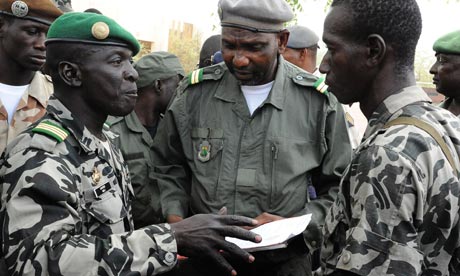
[A Mali coup leader, Captain Amadou Haya Sanogo (left)]

And now we arrive at our current situation.  Arguably the best equipped and trained military force in the Sahel has returned to their ancestral homeland with the express desire of forming an autonomous state.  The various Tuareg groups formed the Mouvement National de Liberation de l”Azawad or MNLA as the new umbrella group of the Tuareg independence movement.  As a result of the recent Tuareg  rebellion two hundred thousand Malians have fled into neighboring countries.  Many fleeing into Niger, already racked by drought and lack of food, have put an enormous strain on the already fragile stability there.  Vastly under equipped the Malian army has tried in vain to put down the rebellion.  President Toure, the long beloved leader, was seen by the Malian public as wholly inadequate at combating the problem.  Protests in Bamako against government inaction turned so violent in February that Tuaregs living there had to flee, lest they face violence and even death.  The MNLA easily took control over large swaths of the North, attacking and killing scores of Malian soldiers.  This instability has led a group of low-level, and according to various reports drunk, army mutineers to overthrow President Toure.  Announced yesterday on state TV, coup leader Captain Amadou Haya Sanogo said that the new government known as the National Committee for the Restoration of Democracy and State (CNRDR) had dissolved both the government and the constitution.  They claim they will hold free elections once stability has been restored to Mali.  The CNRDR main greivenace has been the lack of adequate means with which to combat the Tuareg rebels in the north.

But is this the real reason for the coup?  President Toure was due to step down after the presidential election on April 29th.  This begs the question as to why the army could not wait until a new leader was sworn in.  Or better yet continue to press ATT to be more assertive in fighting the Tuareg.  It is the view of Porkins Policy Review that this is simply just a coup.  Lofty ideas like fighting the Tuareg and restoring stability to Mali are being used as a smoke screen to gain power.  It is true that a segment of the Malian army has been vocal about the incompetence of President Toure in combating the Tuareg.  But it is also true that there is no way that a bunch of drunk low-level soldiers and officers  would have been able to overthrow the president with out some form of political support.  It is Porkins belief that there most certainly is a benefactor supporting the Malian mutineers.  And this benefactor in conjunction with the coup leaders plans to exploit unrest in the North as a justification to grab power and hold on to it.  While crushing the Tuareg rebellion is most likely on the list of things the CNRDR hopes to accomplish, their main goal will be to stay in power.  It also fails to be seen how overthrowing the President will somehow result in the army being better equipped to fight the Tuareg.  It is too soon to really make an educated guess as to what will happen in Mali.  The only thing anyone can definitively say is that the Sahel region is reaching its breaking point.  A massive drought has already effected Northern Mali and especially Niger, leading to conditions likely to result in famine.  Battle hardened Tuareg in Niger may also be dragged into the fight in Northern Mali.  This would putt an even greater strain on Niger which is still unstable after its most recent coup two years ago.  AQIM has consistently been on the rise through out the region; growing in influence and sophistication.  The Tuareg rebellion and now the coup are only adding fuel to the fire.

Boko Haram getting a lot worse

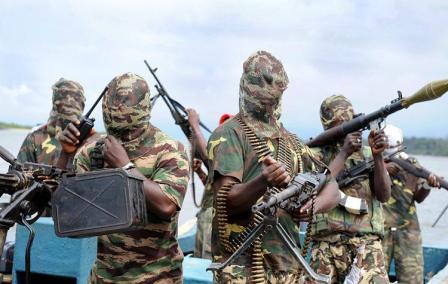
Boko Haram is fast becoming Nigeria’s biggest threat to security.  The radical group wants to implement a strict interpretation of Sharia law through out Nigeria.  They have generally carried out attacks in the North, the traditional heart land of Nigeria’s Muslim population. Maiduguri, the capital of Borno state, has received the brunt of this violence.  In the past few days clashes in Maiduguri have left dozens dead.  Al Jazeera quotes police and local aid workers as saying that the death toll in the region could reach 100.  Boko Haram have also begun to move out of the north.  In August they carried out a spectacular attack on a UN building in the capital Abuja.  There are also reports of bank robberies in the north by the group in order to finance their movement.  Boko Haram now represents a major problem for Africa’s largest economy.  As of right now, President Goodluck Jonathan has done very little in the way of combating them.  Boko Haram does not look as if it is ready to lay down arms.  They have no intention of negotiating with the government either. Along with a criminal insurgency in the oil rich Niger Delta in the south, Nigeria is facing a serious national security crisis.

Much needed change at ICC

Gambian prosecutor Fatima Bensouda will become the new chef prosecutor of the ICC. She will take over from her boss and the current head of the court, Luis Moreno Ocampo, who has shrouded the court in controversy. Ocampo has been criticized for only prosecuting African leaders for war crimes and crimes against humanity. As The Economist points out

All 26 of the suspects publicly indicted by the court have been African; of those in the court’s custody, four are Congolese and one a Rwandan wanted for crimes in Congo.

This marks a huge victory for African nations and people’s. There have been many awful crimes that have been committed by African rulers in the past decade but we need to broaden the scope of the court. Rather than act as a deterrent against committing war crimes; ICC under Ocampo is now viewed as racist and unfair by leaders and people across Africa. How come no one in Israel has been charged with dropping white phosphorus on civilians in Gaza? Why has the Sri Lankan government been spared a serious investigation into war crimes committed in their push to defeat the Tamil Tigers?

International law should not be viewed
as unfair and biased. It makes bad leaders flaunt the law and do as they please. We need to strengthen the power to prosecute bad leaders, while at the same time make sure to prosecute people aside from those residing in Africa.

FPI boycotting vote

Laurent Gbagbo’s  Ivorian Popular Front party (FPI) is boycotting the vote according to Al Jazeera.  They also claim that the election will not be fair because the electoral commission is now controlled by President Ouattara.  This was of course the same line that was used by Ouattara when he was fighting to gain power in the nation.  Even with a fair election taking place the FPI will be able to score huge political points with its base, simply by claiming that the election commission is corrupt.  Sylvain Miaka Ouretto, now in control of the FPI said the elections are  “masquerade organised by the powers in place”.